


Last week, we diagnosed the problem: Discovery scaled. Clinical delivery didn’t. We’re attempting to run 21st-century molecular science and AI solutions on 20th-century delivery infrastructure.
The result is Pilot Purgatory—a graveyard of brilliant algorithms and therapies that never reached scale.
Today, we stop diagnosing. Today, we formalize the solution.
It’s time to introduce a new discipline: Clinical Design; and its central framework, the Vowels of Clinical Design.
Abstract (TL;DR)
The Definition: Clinical Design is the simultaneous engineering of healthcare innovations and the care delivery environment. It is the discipline that turns biomedical discovery into scalable reality.
The Framework: To succeed, you must solve for the Vowels of Clinical Design (AEIOU): Adoption, Evidence, Interoperability, Ownership, and Unit Economics.
The Laws: Friction beats accuracy. The clinical moment is sacred. Incentives are part of the product. Evidence is a loop.
The Reality: If you miss any one vowel, you don’t have a product. You have a science project.
1. The Canonical Definition
Let’s clear the air immediately.
When we say Clinical Design, we are not talking about aesthetics. We are not talking about a prettier app or a sleeker logo. And crucially, we are not talking about clinical trial design.
The definition: Clinical Design is the simultaneous engineering of healthcare innovations and the care delivery environment.
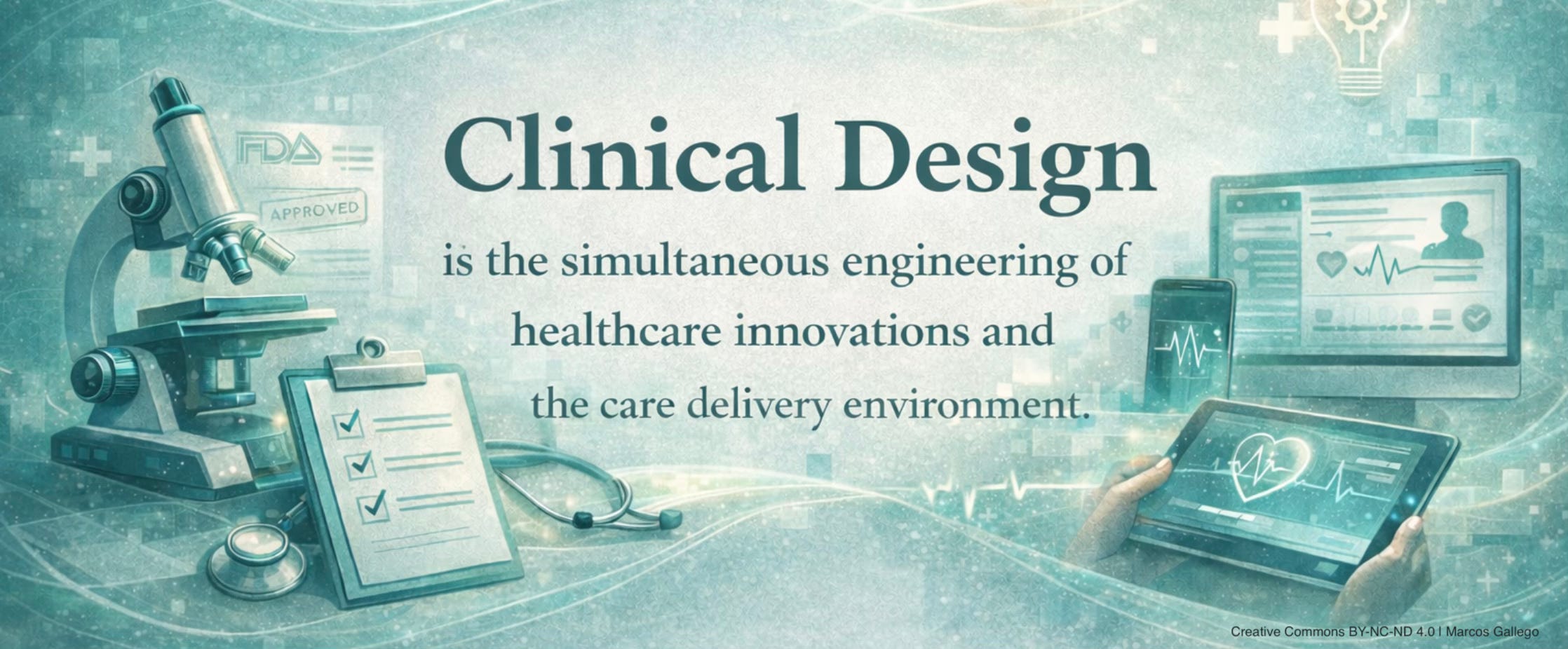
It is the engineering of the socio-technical system that ensures an innovation is actually used, maintained, and creates value in the real world, by aligning workflow, incentives, evidence, interoperability, and accountability.
It operates on a premise the industry still resists:
Implementation is not a logistics problem. It is a dual engineering challenge.
Just as we engineer molecules for safety and digital tools for stickiness, we must engineer environments for adoption.
2. The Outcomes: What Clinical Design Optimizes For
Clinical Design is a discipline with five measurable outcomes. If these don’t move, you didn’t design delivery: you shipped a science project.
To move this from philosophy to engineering, we need a clear framework: call it the Vowels of Clinical Design.
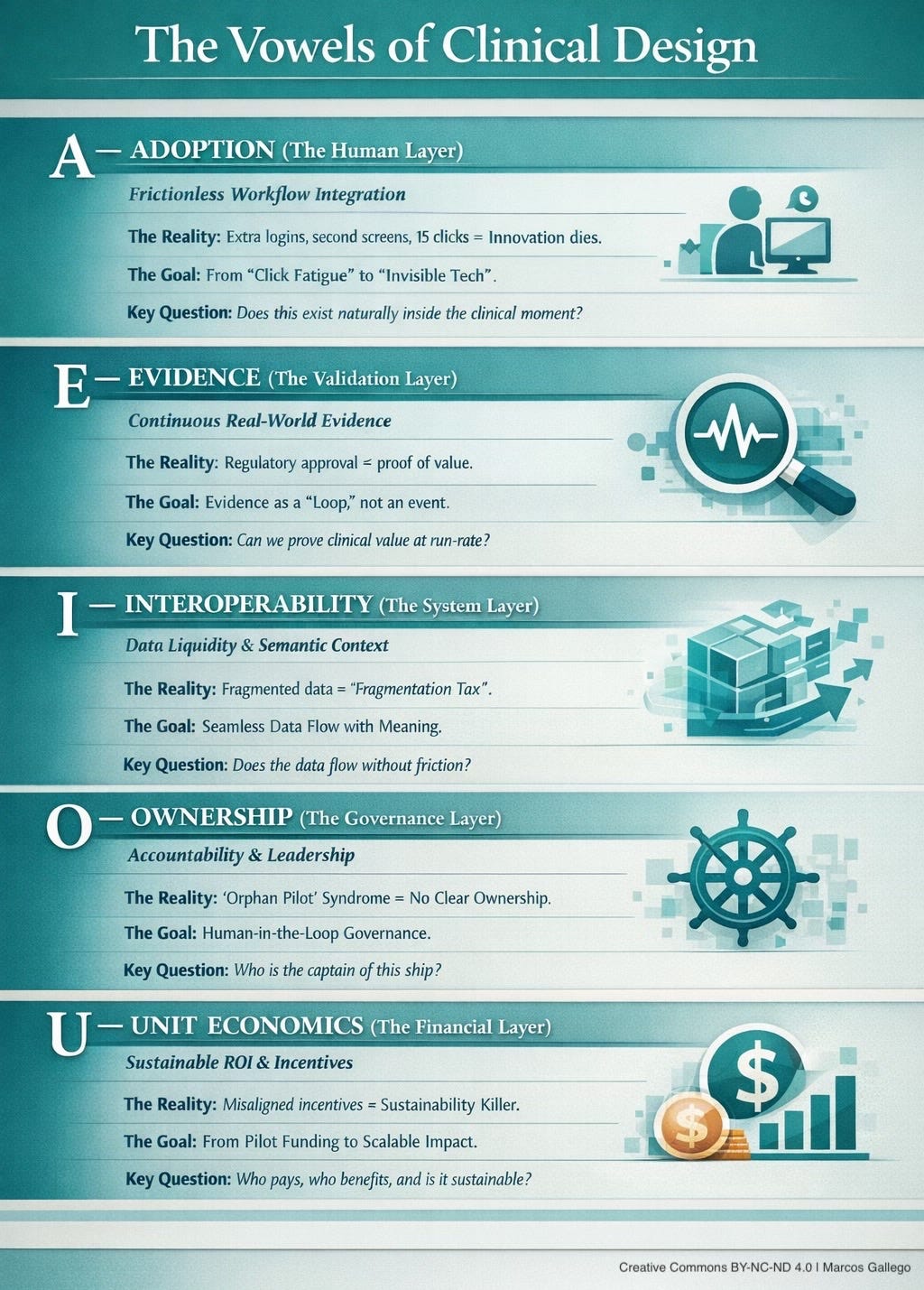
A — ADOPTION (The Human Layer)
Focus: Frictionless workflow integration.
The Reality: If your innovation requires a separate login, a second screen, or 15 clicks, it won’t be used. Not because clinicians are irrational—but because innovation usually dies on a Tuesday at 15:00 AM by adding cognitive load to an exhausted clinician.
The Goal: Move from “Click Fatigue” to “Invisible Tech.” The best clinical design is the one the user barely notices. The solution is felt in time saved and errors avoided, not in attention demanded
Key Question: Does this exist naturally inside the clinical moment?
Stakeholders: Clinicians, nurses, operators
E — EVIDENCE (The Validation Layer)
Focus: Continuous Real-World Evidence (RWE).
The Reality: Regulatory clearance (FDA/CE) is permission to market, not proof of value. Static studies do not predict dynamic performance.
The Goal: Shift from Evidence as an “Event” to Evidence as a “Loop.” Continuous monitoring of safety, drift, and outcomes.
Key Question: Can we prove clinical value at run-rate, not just accuracy in the lab?
Stakeholders: Payers, Regulators, Medical Directors
I — INTEROPERABILITY (The System Layer)
Focus: Data Liquidity and Semantic Context.
The Reality: Healthcare data is “dirty ore.” Most innovations fail because they create a “Fragmentation Tax”—adding yet another isolated silo to the stack.
The Goal: Moving beyond “having an API” to Semantic Reality. Data must flow with meaning to the right place at the right time.
Key Question: Does the data flow without friction, or are we building another walled garden?
Stakeholders: CIOs, IT, Hospital Data Managers
O — OWNERSHIP (The Governance Layer)
Focus: Accountability, Leadership, and Safety.
The Reality: The “Orphan Pilot” problem. Projects fail because responsibility is diffused. Who drives this project forward? Who will get their hands dirty implementing the work? Who owns the risk if the AI hallucinates? Who drives the co-development?
The Goal: Clear Human-in-the-Loop governance. Ownership is not just about who gets the credit; it’s about who drives, who pushes, and who holds the pager when things break. It turns “users” into “leaders.”
Key Question: Who is the captain of this ship?
Stakeholders: Solution owners, pilot owners.
U — UNIT ECONOMICS (The Financial Layer)
Focus: Sustainable ROI and Incentives.
The Reality: Misaligned incentives are the silent killer. If Pathology pays for a tool that saves money for Oncology, the tool will die.
The Goal: A clear path from Pilot Funding to Run-Rate Sustainability: budget owner clarity, procurement reality, and measurable return per stakeholder.
Key Question: Who pays, who benefits, and do the incentives align to keep this alive at scale?
Stakeholders: CFOs, Hospital Leaders, Investors
3. The Physics of Clinical Design (The Inviolable Laws)
Every discipline has laws. Ignore them at your peril.
Law 1 — Friction beats accuracy
A 99% accurate algorithm that adds 10 clicks will fail.
A 90% accurate one that saves 10 clicks will scale.
In care delivery, time is the scarcest resource—not intelligence.
Law 2 — The clinical moment is sacred
If your tool doesn’t exist inside the decision window—inside the viewer/EHR/bedside moment—it doesn’t exist.
You can’t ask clinicians to leave reality to use your product.
Your product must go to them.
Law 3 — Incentives are part of the product
You cannot design the tool without designing the payment logic.
If your tool reduces readmissions (saving the payer) but reduces hospital revenue (hurting the provider), you built a product your customer has an incentive to kill.
Law 4 — Evidence is a loop, not an event
The old model: Study → Approval → Launch
The Clinical Design model: Launch → Design → Refine both → Prove
Software is a living organism. Evidence generation must be alive too.
4) The Blueprint (What changes from here)
Discovery gives us bricks: molecules, models, devices. Clinical Design is the blueprint.
It ensures the building is:
desired (Adoption),
habitable (Evidence),
connected to the grid (Interoperability),
taken care of (Ownership).
and economically viable (Unit Economics).
We spent the last decade obsessed with the bricks. It’s time to obsess over the blueprint.
Welcome to the discipline of Clinical Design.
Next week
I’ll publish the Clinical Design Stack (how to pronounce each vowel) and the Clinical Design Loop (how to build the house): a repeatable method you can use to evaluate any innovation in minutes and see exactly why it will scale (or die in pilot purgatory).
— Marcos
Note & disclaimers:
Context: The Clinical Decade (and this article) explore the theoretical foundations of Clinical Design, a teaching framework created by Marcos Gallego. It has been developed through independent research and academic activities, and is shared here as a personal contribution to the field.
Independence: Views and materials published in The Clinical Decade are personal/independent and do not represent any employer, client, or institution.
License: Licensed under Creative Commons Attribution–NonCommercial–NoDerivatives 4.0 International (CC BY-NC-ND 4.0), unless otherwise stated.