


Abstract
The Race: Between January and April 2026, six major tech companies shipped consumer health AI products: ChatGPT Health (OpenAI), Claude for Healthcare (Anthropic), Amazon Health AI, Microsoft Copilot Health, Perplexity Health, and Google Health AI (Gemini). Nothing like this has happened before.
The Pattern: All six aggregate personal health data (EHRs, wearables, labs) and turn it into explanations, summaries, and visit prep. All six say “not for diagnosis.” All six are trying to become the front door of healthcare.
The Verdict: When graded through the Vowels of Clinical Design (AEIOU), the picture is clear: strong Adoption wedges, early Interoperability connectors, and almost zero Evidence loops, Ownership structures, or Unit Economics at the point of care. These are dashboards. They are not yet circuits.
The Gap: As one physician on X put it: “A dashboard that flags your rising Lp(a) without connecting you to a physician who will actually act on it is not healthcare. It is a sophisticated anxiety generator.” The missing vowel across all six is the human loop.
1. Ninety Days That Redrew the Map
In January, I published an analysis of ChatGPT Health vs. Claude for Healthcare through the lens of Clinical Design.12 At the time, the framing was two companies and one open question: who will succeed?
Well, that framing lasted about eight weeks.
Between January and April 2026, four more products landed. Amazon expanded Health AI to all users via Prime and the Amazon app.3 Microsoft launched Copilot Health, aggregating records from 50,000+ hospitals and 50+ wearable platforms into a single encrypted vault.4 Perplexity shipped Perplexity Health on top of its agentic Computer platform, with connectors to 1.7 million providers.5 And Google kept building Gemini Med and its health stack, though without the singular consumer launch event the others staged.6
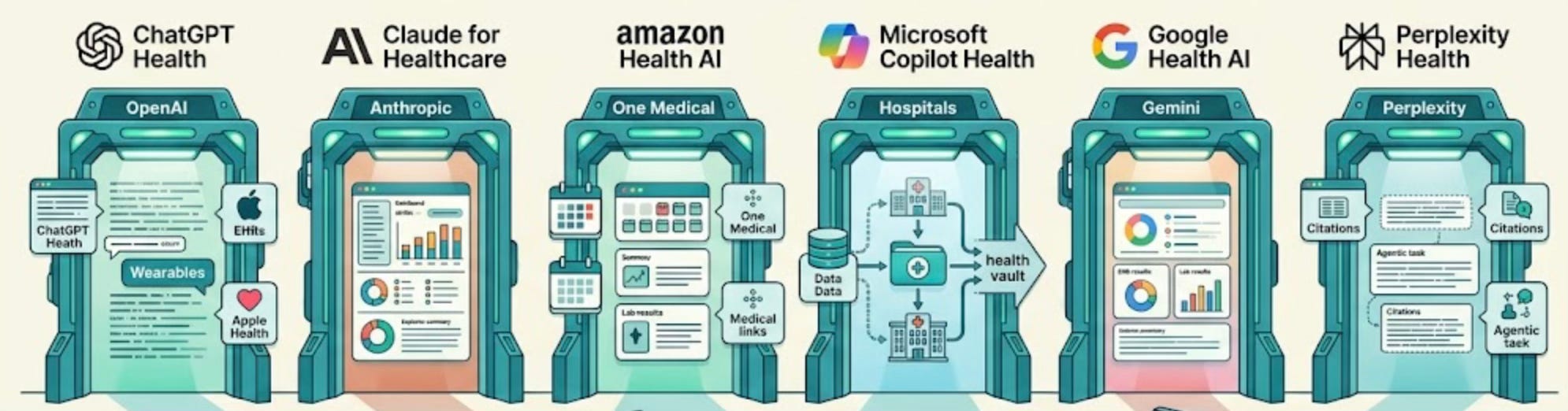
The result: a new category consolidated in real time. The industry is now calling these “AI front doors” to health, and the question is no longer whether LLMs belong in healthcare. The question is whether any of them can get past the lobby.
2. The Six Players: What They Shipped
Before grading, a brief map of what each product actually does. The differences matter more than the similarities.
ChatGPT Health (OpenAI)
A dedicated Health space inside ChatGPT. Connects to medical records and wellness apps (Apple Health, nutrition trackers) via live connectors. The user drives: upload labs, ask questions, iterate. 230 million health queries per week were already flowing through ChatGPT before the launch.7 The product formalized an existing behavior. It didn’t create a new one.
Claude for Healthcare (Anthropic)
Enterprise-first. HIPAA-ready posture, connectors into CMS coverage rules, ICD-10, NPI registry, PubMed, and explicit FHIR development. Targets prior authorization, claims support, care coordination, clinical documentation. The ambition is the operational backbone, not the consumer layer.
Amazon Health AI
The most action-oriented of the six. Explains lab results, renews prescriptions, books appointments with One Medical providers, and gives eligible Prime members up to 5 free direct-message care visits. Built on Amazon Bedrock with a declared multi-agent architecture that includes escalation to licensed clinicians.8 Distribution moat: 200 million Prime users.
Microsoft Copilot Health
The aggregation play. Records from 50,000+ hospitals, 50+ wearable integrations (Apple Health, Oura, Fitbit), and lab results, all funneled into an encrypted “health vault.” On the clinical side, Dragon Copilot handles ambient documentation and note generation.9 Internal research (MAI-DxO) reportedly outperformed physicians on NEJM case studies.10
Perplexity Health
Launched March 19, 2026. The freshest entrant. Sits on top of Perplexity Computer (their agentic platform) and connects Apple Health, wearables (Fitbit, Ultrahuman, Withings; Oura coming), EHR data from 1.7 million providers via b.well and Terra, and lab results. The differentiator: answers grounded in cited medical literature, plus agentic tools that build personalized nutrition plans, training protocols, and visit summaries.11 Pro and Max subscribers in the US only, for now.
Google Health AI (Gemini)
No single consumer launch event. Instead, a continuous stack: Gemini Med (strong medical benchmarks), Personal Health LLM (wearable/sensor integration), and Google Cloud partnerships with CVS Health and Highmark. Gemini 2.5 Pro scored top-2 in recent complex medical question studies. The perception gap: best benchmarks, lowest consumer buzz.
3. The AEIOU Verdict: Six Products, One Framework
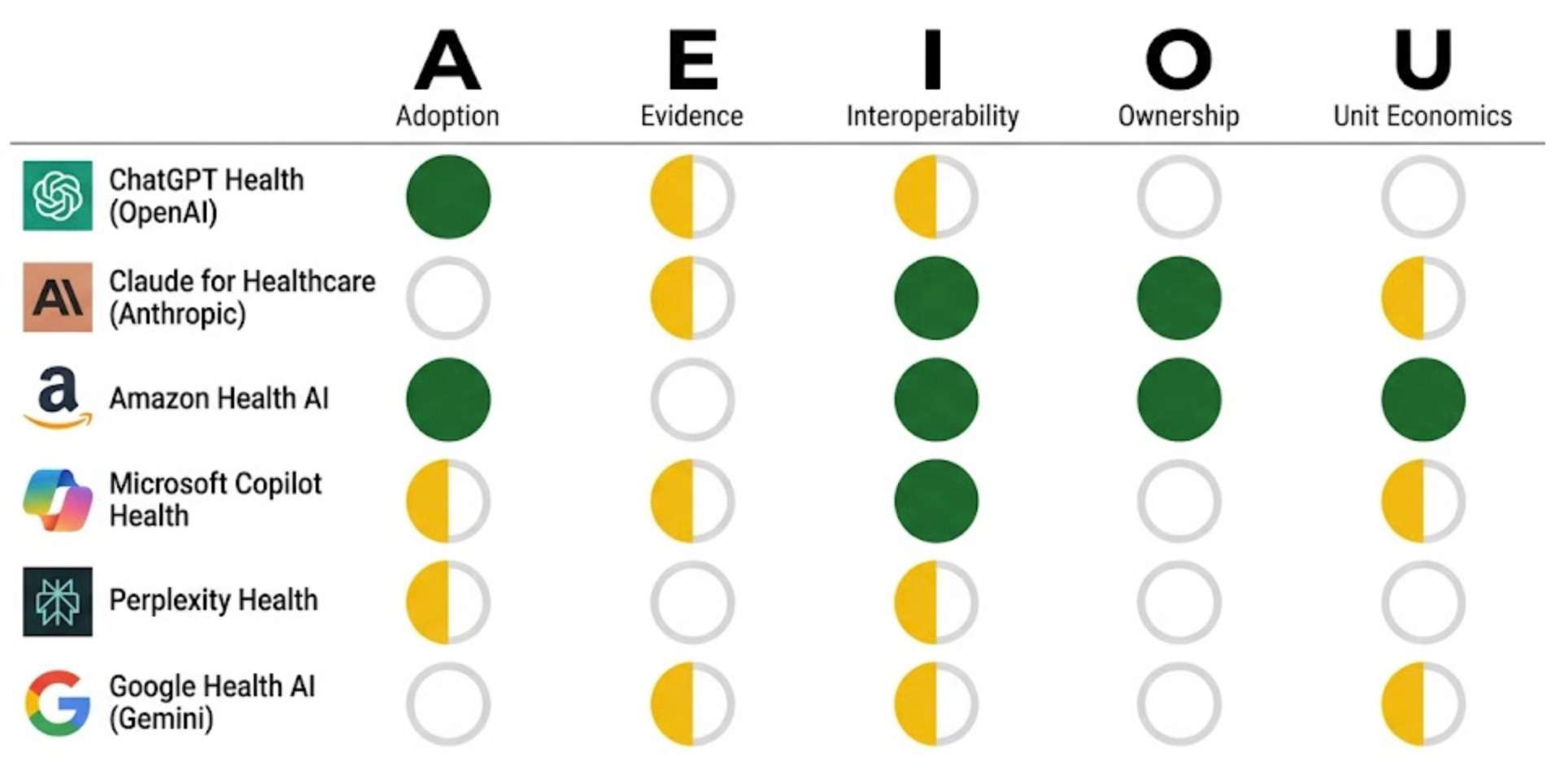
In Article 2, I graded ChatGPT Health and Claude for Healthcare using the Vowels of Clinical Design. Now let’s run all six through the same framework. The pattern that emerges is striking: strong A, partial I, and near-empty E, O, and U across the board.
A — Adoption
Winners: ChatGPT Health and Amazon Health AI.
ChatGPT Health wins because it formalized something people already did. The product didn’t change behavior; it gave existing behavior a home. That’s the lowest-friction adoption wedge possible.
Amazon wins differently: through action. Every other product on this list is fundamentally a conversation. Amazon is the only one that books appointments, renews prescriptions, and connects you to a licensed clinician inside the same flow. Action beats explanation.
Microsoft and Perplexity sit in the middle. Copilot Health’s aggregation is impressive, but its adoption depends on whether users will actively manage a “health vault” (most won’t, unless prompted). Perplexity’s agentic layer is powerful for self-trackers and biohackers, but that’s a niche, not a population.
Claude is the weakest on consumer adoption by design: it’s built for enterprise workflows (prior auth, claims, coding), where the adopter is an institution, not an individual. That’s a deliberate trade-off, not a flaw.
Google has the reach (Search, Android, Fitbit, Pixel) but hasn’t consolidated it into a single consumer moment. The pieces are there. The circuit isn’t.
E — Evidence
No clear winner. This is the weakest vowel across all six.
None of these products have published real-world evidence on clinical outcomes. None have pragmatic trial data. None have continuous monitoring of drift, safety signals, or diagnostic accuracy in the wild.
ChatGPT Health generates personal evidence loops (test a hypothesis on your own data, iterate, discard). That’s useful. But one physician tester reported the model flagging a correlation as “significant” on n=3, then losing it when pressed to go deeper.12 Sample-size blindness in a health product is a design flaw, not a feature gap.
Claude’s operational targets (prior auth time, denial rates, documentation throughput) come with built-in metrics. That’s structurally better for evidence generation than consumer wellness. But the evidence doesn’t exist yet.
Microsoft’s MAI-DxO benchmark is eye-catching (85.5% vs 20% on NEJM cases). A benchmark on curated cases remains a benchmark, not a real-world evidence loop. Google’s Med-Gemini scores are similarly impressive and similarly lab-bound.
The bottom line: none of these products can yet answer the question Clinical Design demands: “Can we prove clinical value at run-rate?”
I — Interoperability
Leaders: Amazon, Microsoft, and Claude (each in different directions).
Amazon connects to clinical action (appointments, prescriptions, escalation to One Medical). Microsoft connects to clinical data (50,000+ hospitals, FHIR, wearable streams). Claude connects to clinical codes (CMS, ICD-10, NPI, PubMed, FHIR development). Three different interoperability bets. All partial.
The shared constraint: none of them have solved what Josh Mandel called the “clinical note text” problem.13 Structured FHIR data without narrative context is not what clinicians experience as “the chart.” Connecting to records is not the same as connecting to the clinical moment.
Perplexity’s connector layer (b.well, Terra, 1.7M providers) is broad but untested at scale. ChatGPT Health connects to the user’s personal data well; it connects to the care delivery system less well. Google’s interoperability lives in Cloud partnerships, not in the consumer product.
O — Ownership
Only Amazon and Claude have legible ownership structures. For different reasons.
Amazon is the only product with a direct human-in-the-loop: One Medical clinicians who can see, validate, and act on AI-surfaced insights. The ownership chain is clear. The AI suggests. The clinician decides. The patient receives care. That’s a circuit.
Claude’s enterprise posture (BAAs, access controls, governance, auditability) creates institutional ownership. When a hospital deploys Claude for prior auth, someone owns that workflow: revenue cycle, clinical ops, utilization management. There’s a pager holder.
The other four are consumer products where ownership is diffuse by default. The user owns the habit. Nobody owns the outcome. And that’s the structural problem a physician on X described with surgical precision: “Every AI company is racing to build the best health dashboard... But a dashboard that flags your rising Lp(a) without connecting you to a physician who will actually act on it is not healthcare. It is a sophisticated anxiety generator.”14
Perplexity’s advisory board (Eric Topol, Devin Mann, Wendy Chung) is a credibility signal, not an ownership structure. Advisory boards don’t hold the pager at 3am.
U — Unit Economics
Amazon has the clearest path. Everyone else is subsidizing.
Amazon monetizes through Prime membership, One Medical visits, and pharmacy integration. The unit economics are visible: reduce friction for the patient, generate visits and prescriptions, capture value through existing commerce infrastructure. It’s the only model where the health AI product has an obvious revenue loop that doesn’t depend on enterprise licensing alone.
Claude sells to institutions (enterprise contracts, BAAs). The ROI case is strong (reduced admin labor, fewer denials, faster throughput), but requires selling into budget owners who may not capture all the value.
Microsoft, OpenAI, and Perplexity are all subscription plays (Pro/Max/365) where health is a retention feature, not a revenue center. That’s fine for now. It’s not a unit economics model for healthcare.
Google’s model is B2B (Cloud partnerships), which has enterprise-grade economics but no consumer-facing health monetization yet.
4. The X Verdict: What the Field Is Actually Saying
The conversation on X in March/April 2026 is the most mature I’ve seen around health AI. The hype-to-substance ratio has improved. Three threads capture the mood.
Thread 1: “All doing basically the exact same thing.” A viral post on March 19 asked the question directly: “GPT Health, Claude Health, Copilot Health, Amazon Health, and now Perplexity Health... all doing basically the exact same thing. Who will win and why?” The fact that this question is being asked publicly, without irony, tells you the category has commoditized at the surface layer. The differentiation lives underneath.
Thread 2: The anxiety generator.” The @agingroy thread became the most cited critique of the entire wave. The argument: connecting records and flagging lab anomalies without closing the loop to a physician who will act is worse than useless. It generates anxiety without resolution. The thread resonated because it describes an experience most early testers recognized.
Thread 3: “Overconfident and wrong.” @dampedspring tested Claude, Gemini, and ChatGPT with real abdominal pain. All three were roughly equivalent, all overconfident, and all missed the diagnosis until the ER confirmed kidney stones.15 The word used was “totally useless.” That’s harsh but instructive: in the consumer frame, these models present with clinical confidence they haven’t earned.
The privacy drumbeat is constant. Every launch gets the same reply pattern: “We take your privacy seriously... same sentence every platform uses right before the breach.”16 The references to 23andMe, MyFitnessPal, and Cerebral are not abstract. They’re recent.
And the startup ecosystem is watching: “Perplexity Health just sent an entire sector of YC back to the drawing board... your startup’s moat was just AI for lab results... you’re now a feature.” 17
Overall sentiment: approximately 70% optimistic realism, 30% cautionary. The optimism is about capability. The caution is about the gap between capability and clinical accountability. That gap is precisely where Clinical Design operates.
5. The Pattern: Dashboards vs. Circuits
If you step back from the feature lists and marketing copy, a single pattern emerges from all six products.
They are all dashboards. Brilliant, data-rich, increasingly well-connected dashboards. But dashboards don’t save lives. Circuits do.
I used this metaphor in Article 3, comparing PRAIM and TRICORDER.
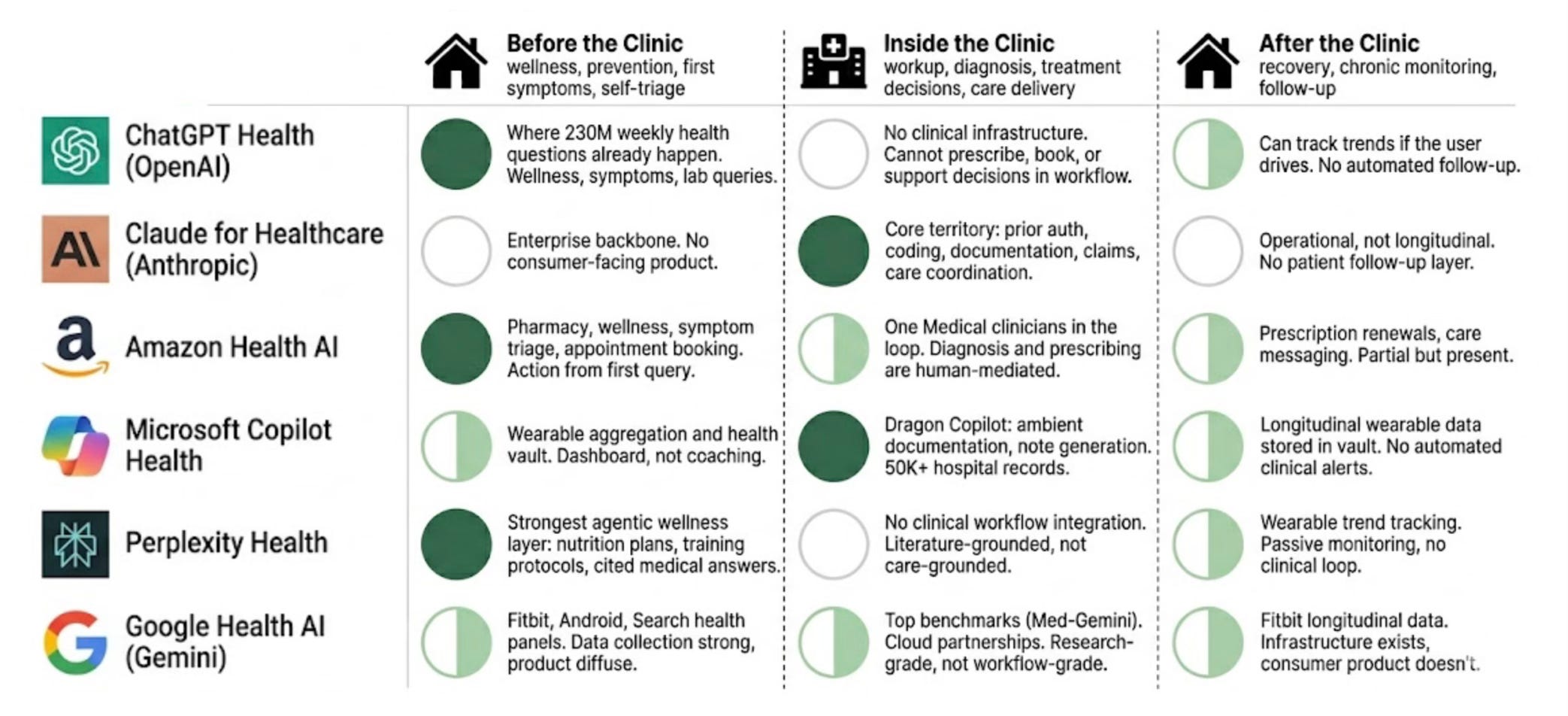
ChatGPT Health is a dashboard for personal wellness. Amazon Health AI is the closest to a circuit (it closes the loop with action and clinicians). Claude for Healthcare is building circuit components for the enterprise backbone. Microsoft is building the data substrate. Perplexity is building an agentic dashboard with cited sources. Google is building the research engine.
None of them are complete yet.
A complete circuit in health AI would look like this: data flows in with semantic meaning (I). The interface exists inside the clinical or personal health moment without friction (A). Continuous evidence validates performance in the real world (E). Someone holds the pager and is accountable for the output (O). And the economics sustain the system at run-rate (U).
That’s the AEIOU framework, fully pronounced. And no product on the market today pronounces all five vowels.
6. What to Watch: The Next 6 Months
The race is on. Here’s what will separate the winners from the features:
Who ships real-world evidence first? The first product to publish pragmatic outcome data (not benchmarks, not case studies, but population-level RWE) will own the Evidence.
Who closes the physician loop? Amazon is closest with One Medical. But the real question is whether any product can embed clinical accountability without owning a provider network.
Who survives the privacy reckoning? A single major breach in one of these products will reshape the entire category. The HIPAA-adjacent posture most of them maintain is necessary but not sufficient.
Who moves beyond the US? All six are US-first (or US-only). The European health system, with its fragmented payers, strict GDPR requirements, and public procurement cycles, is the real stress test. The product that figures out EU scaling first wins a massive structural advantage.
Who makes the startup ecosystem obsolete? If Big Tech health AI products commoditize the “explain my labs” and “prep for my visit” layers, the next generation of health startups will need to build deeper: into specific disease pathways, into operational workflows, into the spaces between these dashboards and the clinical moment.
7. The Call to Action
In January, two companies launched health AI products. By March, six had shipped. The category that didn’t exist in December is now table stakes.
But table stakes are not the same as value delivered.
When I look at these six products through the framework of Clinical Design, I see the same thesis confirmed that this newsletter has argued since Article 0: we have the technology. The algorithms work. The connectors are being built. What’s missing is the discipline of designing systems that close the loop between intelligence and care.
The models are good enough. The data pipes are being laid. The question is no longer “can AI understand health?” The question is: who will build the circuit?
Why I’m doing this: I believe the next 10 years won’t be defined by who discovers the next molecule, but by who figures out how to deliver it.
Whatever your role (clinician, founder, investor, or policy maker) we are all architects of this new system.
Let’s build.
— Marcos
Note & disclaimers
Context: The Clinical Decade (and this article) explore the theoretical foundations of Clinical Design, a teaching framework created by Marcos Gallego Llorente. It has been developed through independent research and academic activities, and is shared here as a personal contribution to the field.
Independence: Views and materials published in The Clinical Decade are personal/independent and do not represent any employer, client, or institution.
License: Licensed under Creative Commons Attribution–NonCommercial–NoDerivatives 4.0 International (CC BY-NC-ND 4.0), unless otherwise stated.








Which benchmark though. USMLE-style MCQ is the easy regime. The ranking scrambles once you move to open-ended dispositional tasks, MedAlign or MIMIC-based scenarios. That's where I'd want to see the head-to-head.